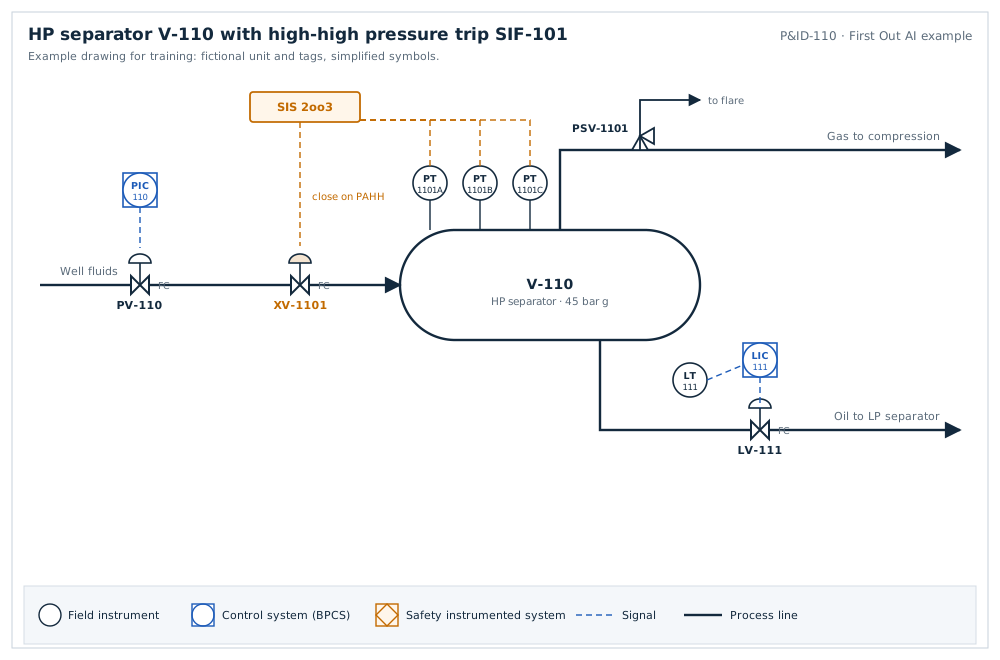
The function
Prevents overpressure and loss of containment of the HP separator if the upstream pressure control fails open or the gas outlet is blocked. The relief valve is not sized for the full gas blow-by case, so the SIF is the main barrier.
Safe state: Inlet shutdown valve closed and the separator isolated from the high-pressure source. Gas outlet valve remains open to the flare header.
Process safety time: 90 s from the trip point to the design pressure (dynamic simulation, worst case). Required response: ≤ 30 s including valve stroke. Setpoint: PAHH at 92 % of design pressure, 2oo3 voting; PAH alarm in the control system at 85 %.
Where the target comes from (LOPA)
Upstream pressure control valve fails open (BPCS loop failure) → HP separator overpressure → loss of containment, flammable gas release, ignition.
| Item | Value | Note |
|---|---|---|
| Initiating event frequency | 0.1 per year | BPCS control loop failure, company LOPA table (illustrative) |
| Probability of ignition | 0.3 | Company ignition probability table (illustrative) |
| Probability of personnel in the affected area | 0.4 | Area occupancy study (illustrative) |
| Relief valve PSV-1101 (sized for blocked outlet, not full blow-by) | 0.01 | Independent of the initiating cause; tested every 4 years |
| BPCS high pressure alarm and operator response | 1 | Not credited: same BPCS as the initiating cause |
| Tolerable frequency | 1e-6 per year | Company tolerable frequency for multiple fatalities (illustrative) |
Mitigated event frequency without the SIF: 1.2 × 10⁻⁴ per year. Required risk reduction factor: 120. Required PFDavg: 8.3 × 10⁻³. Target: SIL 2.
Inputs (illustrative values)
| Group | Voting | λDU /h | λDD /h | λSU /h | β | T1 | PTC | Partial stroke | Type | SC |
|---|---|---|---|---|---|---|---|---|---|---|
| Pressure transmitters PT-1101A/B/C | 2oo3 | 1e-7 | 5e-7 | 5e-8 | 5 % | 1 yr | 95 % | – | B | SC 3 |
| Safety PLC | 1oo1 | 5e-9 | 1e-6 | 0 | 0 % | 10 yr | 99 % | – | B | SC 3 |
| Inlet SDV XV-1101 with solenoid | 1oo1 | 9e-7 | 0 | 1.6e-6 | 0 % | 1 yr | 80 % | – | A | SC 3 |
Mission time 20 years, low demand (PFDavg). Failure rates are illustrative values written for First Out AI, not taken from any certificate or database.
Result (First Out AI engine v0.3.0)
| Measure | Value |
|---|---|
| PFDavg | 0.019 |
| SIL by probability | 1 |
| SIL by IEC 61511 fault tolerance | 2 |
| Systematic capability | SC 3 |
| Achieved SIL | 1 (does not meet SIL 2) |
| Required PFDavg | 8.3e-3 (not met) |
| Mean time to spurious trip | 20.3 years |
| Group | Voting | PFDavg | Share | HFT / required | SFF |
|---|---|---|---|---|---|
| Pressure transmitters PT-1101A/B/C | 2oo3 | 4.5 × 10⁻⁵ | 0 % | 1 / 0 | 85 % |
| Safety PLC | 1oo1 | 2.3 × 10⁻⁴ | 1 % | 1 / 0 | 100 % |
| Inlet SDV XV-1101 with solenoid | 1oo1 | 0.019 | 99 % | 0 / 0 | 64 % |
Engineer's reading
- Inlet SDV XV-1101 with solenoid carries 99 % of the PFDavg, so improvements there matter most.
- With a perfect proof test (the Free plan assumption) the PFDavg would be 4.2 × 10⁻³; the difference to 0.019 is the effect of the realistic proof test coverage.
- The function does not meet its target. Typical options: improve the proof test coverage of Inlet SDV XV-1101 with solenoid, shorten its test interval, add partial stroke testing, or add redundancy with separate solenoids and air supplies; recalculate each option in First Out AI.
Open this example in First Out AI: SIL verification → Examples → "Separator high pressure: close inlet shutdown valve".
Written for First Out AI as engineering guidance. It supports engineering work and does not replace it; check every value against your standards, certificates and company rules with a competent functional safety engineer.