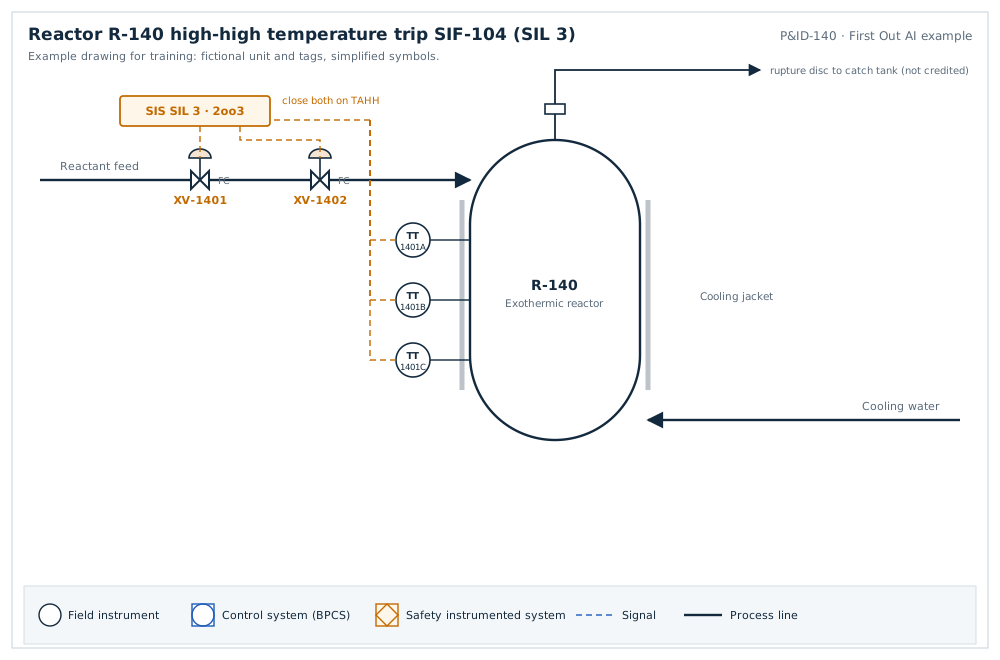
The function
Stops the reactant feed on high reactor temperature to prevent a thermal runaway, overpressure and rupture of the reactor with release of toxic material.
Safe state: Both feed valves closed; cooling remains in service.
Process safety time: 10 min from TAHH to the runaway onset (reaction calorimetry). Required response: ≤ 60 s. Setpoint: TAHH 15 °C above normal operating temperature, 2oo3 on three thermowells at different heights.
Where the target comes from (LOPA)
Cooling water pump trip → loss of reactor cooling during the exothermic phase → thermal runaway → reactor overpressure and rupture, toxic release.
| Item | Value | Note |
|---|---|---|
| Initiating event frequency | 0.2 per year | Cooling water pump trip, site maintenance records (illustrative) |
| Fraction of time the reactor is in the exothermic phase | 0.5 | Batch cycle time analysis |
| Probability of personnel in the affected area | 0.5 | |
| Probability of fatal injury from the toxic release | 0.5 | |
| BPCS high temperature alarm and operator stops the feed | 0.1 | Different sensor and different cause from the initiating event |
| Rupture disc to catch tank | 1 | Not credited: not sized for two-phase runaway flow |
| Tolerable frequency | 1e-6 per year | Multiple fatalities (illustrative) |
Mitigated event frequency without the SIF: 2.5 × 10⁻³ per year. Required risk reduction factor: 2,500. Required PFDavg: 4.0 × 10⁻⁴. Target: SIL 3.
Inputs (illustrative values)
| Group | Voting | λDU /h | λDD /h | λSU /h | β | T1 | PTC | Partial stroke | Type | SC |
|---|---|---|---|---|---|---|---|---|---|---|
| Temperature transmitters TT-1401A/B/C | 2oo3 | 1.2e-7 | 6e-7 | 8e-8 | 5 % | 1 yr | 95 % | – | B | SC 3 |
| Safety PLC | 1oo1 | 5e-9 | 1e-6 | 0 | 0 % | 10 yr | 99 % | – | B | SC 3 |
| Feed valves XV-1401/1402 | 1oo2 | 1e-6 | 0 | 1.2e-6 | 10 % | 2 yr | 80 % | 3 mo / 60 % | A | SC 3 |
Mission time 20 years, low demand (PFDavg). Failure rates are illustrative values written for First Out AI, not taken from any certificate or database.
Result (First Out AI engine v0.3.0)
| Measure | Value |
|---|---|
| PFDavg | 2.7 × 10⁻³ |
| SIL by probability | 2 |
| SIL by IEC 61511 fault tolerance | 3 |
| Systematic capability | SC 3 |
| Achieved SIL | 2 (does not meet SIL 3) |
| Required PFDavg | 4e-4 (not met) |
| Mean time to spurious trip | 18.1 years |
| Group | Voting | PFDavg | Share | HFT / required | SFF |
|---|---|---|---|---|---|
| Temperature transmitters TT-1401A/B/C | 2oo3 | 5.5 × 10⁻⁵ | 2 % | 1 / 1 | 85 % |
| Safety PLC | 1oo1 | 2.3 × 10⁻⁴ | 9 % | 1 / 1 | 100 % |
| Feed valves XV-1401/1402 | 1oo2 | 2.4 × 10⁻³ | 89 % | 1 / 1 | 55 % |
Engineer's reading
- Feed valves XV-1401/1402 carries 89 % of the PFDavg, so improvements there matter most.
- The function does not meet its target. Typical options: improve the proof test coverage of Feed valves XV-1401/1402, shorten its test interval, add partial stroke testing, or add redundancy with separate solenoids and air supplies; recalculate each option in First Out AI.
Open this example in First Out AI: SIL verification → Examples → "Reactor high temperature: stop feed (SIL 3, partial stroke)".
Written for First Out AI as engineering guidance. It supports engineering work and does not replace it; check every value against your standards, certificates and company rules with a competent functional safety engineer.